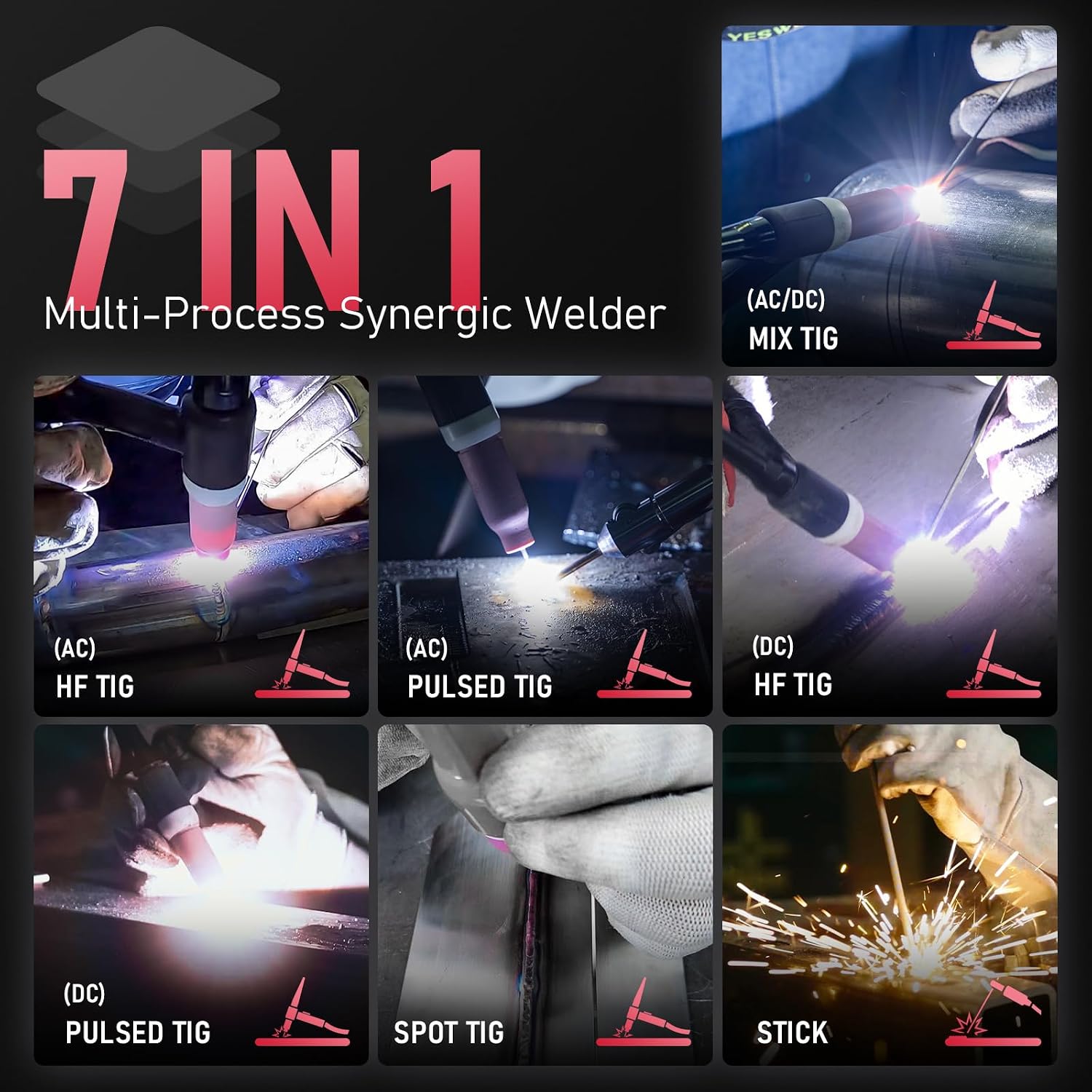
Aluminum gives a lot of welders trouble — not because it’s impossible to weld, but because the machine settings that work fine on steel will absolutely destroy an aluminum bead. The biggest culprit is a setting called AC balance (sometimes labeled “EN balance” or “cleaning balance”), and it shows up on the spec sheet of every AC/DC TIG welder aimed at aluminum work. If you’ve ever wondered why your weld pool looks dirty, why your tungsten keeps balling up, or why a machine that costs twice as much seems to produce noticeably cleaner welds on aluminum, AC balance is almost certainly the answer. This guide will explain what AC balance actually does, how to read that spec before you hand over money, and which range to prioritize depending on what you’re welding — with real machine comparisons and the math to back it up.
| EDITOR'S PICK[Lincoln Electric Square Wave® 2…](https://www.amazon.com/dp/B0BTMVVG35?tag=greenflower20-20) | Mid-tier[New Everlast PowerTIG 200DV 110…](https://www.amazon.com/dp/B01BLUV02O?tag=greenflower20-20) | Budget pick[LOTOS TIG200ACDC 200A AC/DC Alu…](https://www.amazon.com/dp/B00AFM33R0?tag=greenflower20-20) | |
|---|---|---|---|
| Pulse | — | ✓ | — |
| Foot Pedal | — | — | ✓ |
| Argon Regulator | — | — | ✓ |
| Dual Voltage | — | ✓ | ✓ |
| Amps AC/DC | 205 | 200 | 200 |
| Price | $1,599.00 | $1,079.00 | $480.00 |
| See on Amazon → | See on Amazon → | See on Amazon → |
What AC Balance Actually Does (And Why It Matters)
TIG welding aluminum requires alternating current, or AC — that’s the “AC” part of an AC/DC TIG machine. AC means the current reverses direction in a cycle, and that reversal is doing two very different jobs simultaneously.
The electrode-negative (EN) half of the cycle drives heat into the base metal. This is where your actual fusion happens. More EN time means deeper penetration and a narrower bead — the arc is working hard on the aluminum itself.
The electrode-positive (EP) half of the cycle does something called oxide cleaning. Aluminum naturally grows a thin but tough layer of aluminum oxide on its surface (think of the dull, matte look on raw aluminum versus the bright, shiny interior of a fresh cut). That oxide layer melts at roughly 3,700°F — more than twice the melting point of the aluminum underneath it. Without EP current breaking that oxide layer up, you’d be trying to weld through a ceramic shell. The EP phase essentially blasts the oxide away, leaving clean metal for the weld pool to form in.
AC balance is the control that adjusts how much of each cycle is spent in EN versus EP. It’s expressed as a percentage — usually the EN percentage. So a setting of 70% EN / 30% EP means the machine spends 70% of each cycle driving heat into the base metal and 30% cleaning.
Here’s the tradeoff, and this is the crux of the entire buying decision:
- More EN (higher EN%) → better penetration, narrower bead, less heat input, longer tungsten life, smaller cleaning zone
- More EP (lower EN%, higher EP%) → wider cleaning zone, brighter cosmetic bead, more heat into the electrode (tungsten balls up faster, needs to be larger), more overall heat input into the part
For most production aluminum work — box tubing, plate fab, pipe — you want a machine that gives you a wide adjustment range on the EN side, typically 60–85% EN. For thin sheet or cosmetically critical work where appearance matters more than speed, you might dial toward the EP side. The problem is that many entry-level machines lock you into a narrow range, or default to settings optimized for cosmetic show welds rather than structural production welds.
How to Read the Spec Sheet: The Numbers That Matter
When you’re comparing machines, the AC balance spec will appear in one of a few formats. Here’s what you’re actually reading:
By the Numbers
| Spec Format | What It Means | Practical Range to Look For |
|---|---|---|
| ”AC Balance: 20–80%“ | EN percentage, adjustable | 60–80% EN for most aluminum work |
| ”Cleaning: 15–50%“ | EP percentage labeled | Lower number = more EN; aim for 15–25% for production |
| ”Balance: ±50 steps” | Proprietary scale | Check the manual for what center point equals |
The Lincoln Electric AC TIG welding documentation notes that most aluminum structural applications fall in the 65–75% EN range, with thin decorative work sometimes going as low as 55% EN for a wider, brighter cleaning zone.
Miller Electric’s aluminum welding guide puts it more bluntly: machines that only offer a fixed 50/50 balance are designed for hobbyist applications and will struggle with heat management on anything thicker than 3/16” or thinner than 16 gauge, where balance extremes matter most.
AC Frequency is the second spec you need to read alongside balance. This is how many times per second the current reverses direction — typically between 20 Hz and 400 Hz on modern inverters. Higher frequency (150–250 Hz) produces a tighter, more focused arc that’s easier to direct precisely. Lower frequency (40–80 Hz) creates a softer, wider arc better suited to filling large gaps or welding heavier plate. Budget machines often fix this at 60 Hz (standard utility frequency). Mid-market and professional machines let you adjust it — that flexibility is worth paying for.
Machine Comparison: Where AC Balance Separates the Tiers
Let’s look at how real machines handle this spec across price tiers. These comparisons are drawn from published manufacturer specifications and operator community reports on WeldingWeb and similar forums — not from direct machine evaluation.
Entry tier ($500–$900): Machines like the AHP AlphaTIG series publish AC balance ranges of roughly 30–70% EN. That lower ceiling at 70% means you’re giving up some of the penetration and tungsten-life advantages of the 75–85% EN range that experienced aluminum welders often prefer for thicker material. For hobbyist aluminum welding — a set of motorcycle footpegs, a small intake manifold repair — this is workable. For daily production on structural aluminum, operators on WeldingWeb forums consistently report the narrower range becomes a real constraint within the first few months of serious use.
Mid-market ($1,200–$2,800): The ESAB Rebel EMP 235ic is a good reference point here. Per ESAB’s published product documentation, it offers AC balance adjustment across a 30–70% EN range with AC frequency adjustable from 20–250 Hz. The frequency range is genuinely competitive. Operators running this machine on aluminum report it handles up to 3/8” aluminum plate without difficulty at the right balance and amperage settings. The Lincoln Square Wave TIG 200 in this tier offers similar balance range with the added benefit of Lincoln’s well-documented Square Wave AC output — which produces sharper arc transitions than sine-wave AC and allows more precise balance control at each frequency setting, per Lincoln Electric’s own application notes.
Professional tier ($3,000–$7,000+): This is where the spec gap becomes significant. The Miller Dynasty 280 DX (manufacturer-rated) offers AC balance from 20–90% EN and AC frequency from 20–400 Hz. The upper end of that range — 85–90% EN — is meaningful for high-production aluminum pipe and structural work where heat input management and tungsten longevity directly affect throughput. The Fronius MagicWave series (per Fronius technical documentation) goes further with digitally controlled AC waveform shaping, allowing operators to adjust not just balance and frequency but the shape of each half-cycle — trapezoidal versus sinusoidal — for fine-tuned oxide cleaning control that no fixed-format machine can match.
The practical gap between the Dynasty 280 DX and a mid-market machine isn’t a luxury gap — it’s a production math gap. If you’re doing certified structural aluminum welds under AWS D1.2 on a job site where you’re running 6+ hours of arc-on time per day, the wider balance range and higher-frequency precision reduce rework rates and tungsten consumption in ways that show up in your cost-per-foot numbers within weeks.
The Decision Framework: If X, Then Y
Here’s the honest breakdown for where you are right now:
If you’re doing occasional aluminum repairs or hobby fabrication (under 5 hours/week of aluminum TIG): A machine with 30–70% EN balance and fixed or lightly adjustable frequency is sufficient. Prioritize overall machine quality and amperage headroom over AC balance range. The AHP AlphaTIG or Lincoln Square Wave TIG 200 covers this.
If you’re running a small shop doing regular aluminum work — tube chassis, marine components, light structural — and you’re on the machine more than 10 hours a week: You need at least a 25–75% EN range, adjustable frequency to at least 200 Hz, and a duty cycle (the percentage of a 10-minute window the machine can weld before needing to cool down — more on this below) rated at 60% or better at your working amperage. The ESAB Rebel 235ic and Lincoln Square Wave TIG 200 compete well here. The Miller Multimatic 220 AC/DC is another machine spec-sheet reviewers frequently compare at this level for shops that also need MIG capability.
If you’re doing certified structural aluminum welds, production pipeline or pressure vessel work, or you’re billing clients on aluminum structural contracts: The math points to the Dynasty 280 DX or Fronius MagicWave tier. The wider EN range (to 90%), programmable memory for certified procedure storage, and arc stability at high frequency aren’t amenities — they’re the spec requirements that let you run a procedure qualification record (PQR) with confidence and reproduce it job after job.
One number to sanity-check before you buy: Divide your average daily aluminum arc-on time by 10. If that number (as a percentage) exceeds the machine’s rated duty cycle at your typical amperage, you’re shopping in the wrong tier regardless of how good the AC balance range looks. A machine rated at 40% duty cycle at 200A will throttle or shut down before you want it to on a real production day.
What to Ask Before You Pull the Trigger
Before signing a purchase order, get answers to these three questions from the spec sheet or your distributor:
-
What is the full AC balance adjustment range, expressed in EN%? If the spec sheet uses a proprietary scale, ask the distributor to map it to EN percentage. Any rep worth working with can answer this.
-
What is the AC frequency range, and is it adjustable independently of balance? On some machines, frequency and balance interact in constrained ways. Independent control is the professional standard.
-
What is the duty cycle at the amperage I’ll actually run? Nameplate duty cycles are almost always stated at maximum amperage. If you’re running 180A on 1/4” aluminum plate, ask for the duty cycle at 180A — not at 280A. Miller Electric and Lincoln Electric both publish full duty cycle curves in their documentation; ESAB does as well. If a manufacturer won’t publish the full curve, that’s information too.
AC balance is one of those specs that looks minor on a comparison sheet but shapes every aluminum weld you make on that machine. Get the range right for your work, verify the frequency flexibility, and the rest of the buying decision gets a lot cleaner.