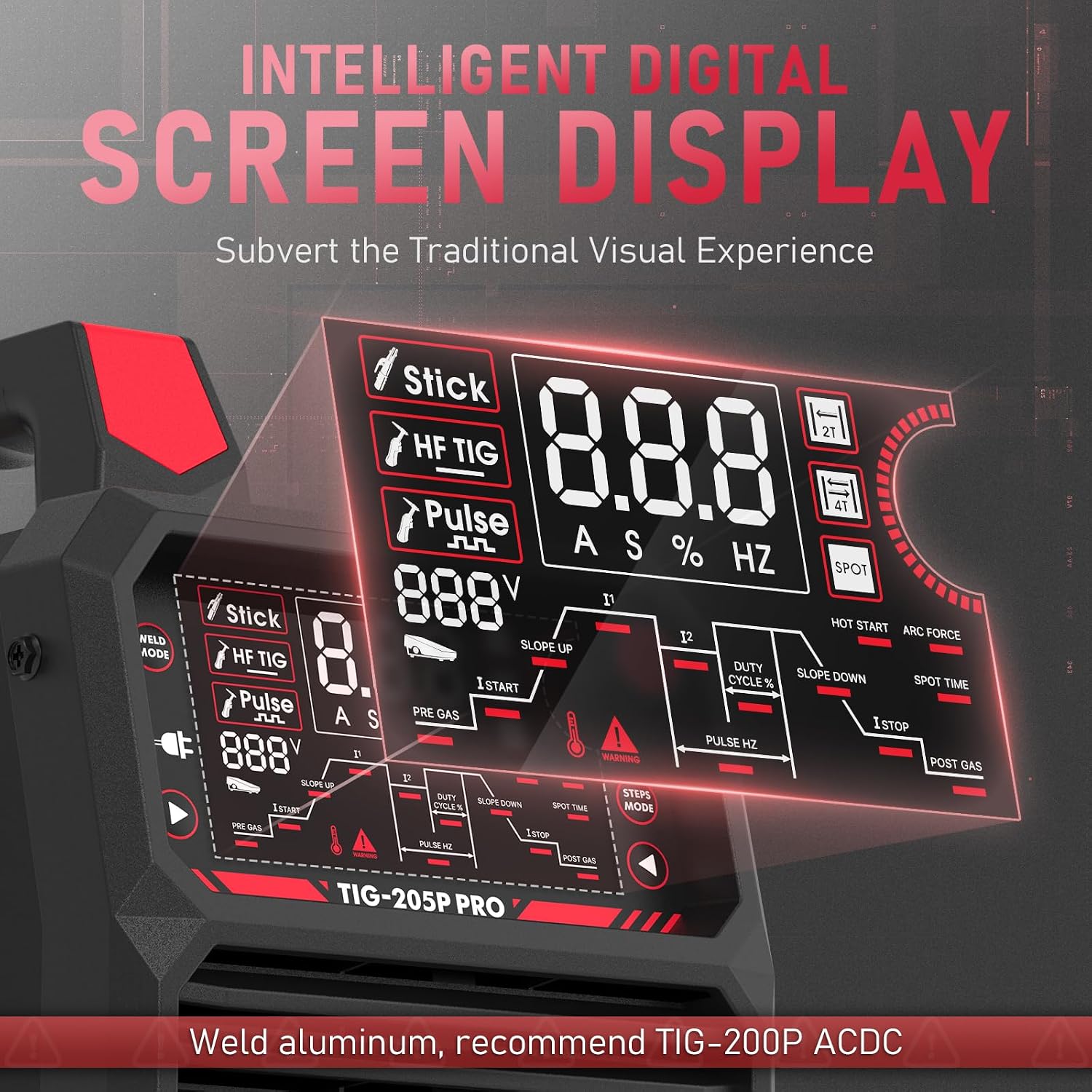
You’ve probably done it at least once: you’re running a bead on 16-gauge stainless tubing and the puddle suddenly blows through the base metal like you aimed a torch at wet cardboard. Or you’re welding 4130 chrome-moly (a steel alloy used in aircraft frames, roll cages, and high-performance tubing because it’s strong and lightweight) and the heat-affected zone — the band of metal surrounding the weld that gets hot enough to change its properties, even if it doesn’t melt — grows so wide you can see the discoloration creeping down the tube. Both problems share a root cause: too much heat piling up in metal that can’t absorb or shed it fast enough.
DC pulse TIG is the specific solution most professionals reach for here. “DC pulse” means the welder’s output current alternates rapidly between a high peak level and a lower background level, instead of flowing at one steady value. That pulsing rhythm controls exactly how much heat you’re putting into the part and when. This article will walk you through how pulse frequency — how many times per second the current cycles between peak and background — changes your weld behavior, why it matters more than almost any other parameter on thin stainless and chrome-moly, and how to choose a machine whose pulse control is actually useful in production.
What Pulse Frequency Is Really Doing to Your Heat Input
Here’s the mental model that makes everything click: a steady DC TIG arc is like leaving a faucet running continuously. Pulse TIG is like turning that faucet on and off in a rhythm. At any given average amperage, the pulsed arc dumps heat into the base metal in concentrated bursts — then backs off during the background phase, giving the metal a brief moment to shed that heat before the next peak hits.
The frequency — measured in pulses per second, or Hz — determines how tightly those on/off cycles are packed together.
-
Low frequency (0.5–2 Hz): You can literally see the puddle freeze and reheat with each pulse. This is “walking the cup” territory — the slow rhythm coordinates with your filler rod dips and torch movement. It gives you exceptional control on root passes and out-of-position work. The heat-input reduction is real but modest.
-
Mid frequency (2–20 Hz): The puddle stays fluid but the arc is visibly tighter and more focused. This range is where most thin stainless and chrome-moly work happens in small shops. You get meaningful heat reduction without the arc becoming hard to follow.
-
High frequency (20–500 Hz): The pulses are too fast to see individually; the arc appears to “pinch” into a narrow, stable column. At this range — sometimes called high-speed or high-frequency pulse — the arc force is dramatically increased, penetration depth improves for a given amperage, and heat input per unit length drops significantly. This is where production pipe shops and aerospace fabricators operate.
Per Miller Electric’s Pulsed TIG Welding Guide, high-frequency pulse in the 100–500 Hz range can reduce heat input by 30–50% compared to a steady DC arc at the same average amperage setting. That’s not a marginal gain — on 0.065-inch wall stainless tubing, that difference is often the margin between a clean bead and a burned-through part.
Why Stainless and Chrome-Moly Demand This Approach
These two materials punish excess heat in different ways, and understanding the mechanism tells you which frequency range to prioritize.
304 and 316 stainless steel conduct heat roughly one-third as efficiently as mild steel. That means the heat you put in goes nowhere fast — it just builds up at the weld zone. The consequence isn’t just distortion (though thin panels will warp badly). At sustained high temperatures, stainless is vulnerable to sensitization — a process where chromium carbides form along grain boundaries and rob the metal of corrosion resistance. Per the ESAB TIG Welding Handbook, sensitization becomes a real risk when 304-series stainless is held between roughly 800°F and 1,500°F (425–815°C) for more than a few seconds. Pulse TIG’s intermittent heat application keeps the time-at-temperature short. High-frequency pulse in particular gets the work done before heat can soak laterally.
4130 chrome-moly conducts heat better than stainless but is sensitive to its own failure mode: hydrogen-assisted cracking and hardening in the heat-affected zone. The Lincoln Electric Procedure Handbook of Arc Welding notes that chrome-moly steels have higher hardenability than plain carbon steels — rapid heat cycles can produce hard martensite zones that are brittle and crack-prone. Pulse TIG’s ability to control peak heat while maintaining a tight arc column reduces HAZ width without requiring excessive preheat on thinner wall sections. For tube walls below 0.120 inches, many aerospace and motorsport fabricators run high-frequency pulse (100–250 Hz) specifically to keep the HAZ narrow and the interpass temperature manageable.
By the Numbers
| Material | Thermal Conductivity vs. Mild Steel | Primary Heat Risk | Recommended Pulse Range |
|---|---|---|---|
| 304/316 Stainless | ~30% of mild steel | Sensitization, distortion | 20–200 Hz |
| 4130 Chrome-Moly | ~70% of mild steel | HAZ hardening, cracking | 50–250 Hz |
| Mild steel (baseline) | 100% | Baseline reference | 2–50 Hz typical |
Sources: ESAB TIG Welding Handbook; Lincoln Electric Procedure Handbook of Arc Welding, 15th Ed.
The Four Pulse Parameters You Actually Need to Dial In
Frequency is only one of four interdependent controls. Most intermediate operators know they exist but haven’t built the intuition for how they interact. Here’s the short version:
1. Peak amperage: The high point of the pulse cycle. This drives penetration and fusion. Set it to what you’d use as your steady-state amperage for the base metal thickness — roughly 1 amp per 0.001 inch of material thickness as a starting point for steel alloys.
2. Background amperage: The low point, expressed either in amps or as a percentage of peak. This keeps the arc stable and the puddle from going completely cold. Most operators run 25–40% of peak for thin material. Too low and you get arc instability; too high and you lose the heat-reduction benefit.
3. Pulse width (duty cycle): How long each cycle spends at peak amperage versus background, expressed as a percentage. At 50% pulse width, the arc spends equal time at peak and background. For heat-sensitive applications, dropping to 30–40% pulse width while maintaining frequency increases the heat-reduction effect. Fronius’s TIG Welding Process Overview describes pulse width as the “fine tuning” knob once frequency and amperage are set.
4. Frequency (Hz): As covered above — controls arc focus, puddle behavior, and how visible the pulsing is to the operator.
These four interact. Doubling your frequency while keeping pulse width at 50% doesn’t automatically cut heat in half — the average amperage delivered stays nearly the same. The real heat reduction comes from the combination of frequency, reduced pulse width, and a peak amperage calibrated to the job.
Machines That Deliver Useful Pulse Control (and Where Cheaper Units Fall Short)
Here’s the honest commercial reality: not every TIG inverter with “pulse” in the spec sheet gives you control that matters for thin stainless and chrome-moly work.
Budget and entry-level units (under $1,000) frequently cap pulse frequency at 10–20 Hz and offer no independent pulse width control. That’s fine for controlling puddle rhythm on mild steel out of position, but it won’t give you the arc-pinching effect on thin-wall stainless. Operators on WeldingWeb and weldingtipsandtricks.com consistently note that single-knob pulse implementations at this price tier leave experienced welders wanting more granularity.
Mid-market multi-process machines in the $1,500–$2,500 range — including the ESAB Rebel EMP 235ic and Lincoln Electric Square Wave TIG 200 — offer pulse frequency up to 500 Hz with independent control of background amperage and pulse width. This is the tier where DC pulse becomes genuinely useful for production thin-wall work. Published specs on the Square Wave TIG 200 (per Lincoln Electric’s product documentation) show 0.1–500 Hz frequency range with independently adjustable pulse width and background — enough range for aerospace chromoly tube work.
Professional-tier TIG inverters in the $3,000–$8,000+ range — the Miller Dynasty 280 DX, Lincoln Electric Precision TIG 375, and Fronius TransTig series — add advanced waveform shaping, memory programs, and in some cases up to 5,000 Hz pulse capability. These machines are specified for aerospace, nuclear, and certified structural applications where the combination of weld procedure qualification (per AWS D1.1 and D17.1 requirements) and repeatable parameter recall justifies the price. Operators at production pipe shops frequently cite the Dynasty platform’s pulse stability at high frequency as a key differentiator in long-run reviews — the arc stays consistent across a full shift in ways that budget inverters don’t maintain.
The tradeoff to name explicitly: If your work is primarily 1/8-inch and thicker stainless structural fabrication with only occasional thin-wall passes, the mid-market tier is almost certainly sufficient. If you’re doing volume tube work on 0.065-inch chromoly frames, roll cages, or aircraft components where every bead needs to match a qualified procedure, the professional tier pays for itself in reduced reject rates and rework time.
Decision Framework: Which Setup Fits Your Work
If X, then Y — let’s be direct:
-
If you’re welding thin stainless or 4130 on a hobbyist or occasional basis (under 10 hours/week): A mid-market machine with 0–500 Hz pulse range and independent background/pulse-width controls is your ceiling. Spending more doesn’t unlock capability you’ll use. The ESAB Rebel EMP 235ic and Lincoln Square Wave TIG 200 are well within this range and have the pulse architecture that actually matters.
-
If you’re a small shop doing regular chromoly tube fabrication — exhaust work, motorsport chassis, structural 4130 — and your customers or certifications demand documented weld procedures: Step to the professional tier. The parameter memory and waveform consistency on machines like the Miller Dynasty 280 DX or Fronius TransTig reduce the human variable enough to protect your qualification records.
-
If you’re evaluating for a production floor or aerospace subcontract where AWS D17.1 (aerospace fusion welding standard) or equivalent governs your work: The professional tier isn’t optional. Fronius and Miller both publish compliance documentation for their Dynasty and TransTig lines that supports procedure qualification — that paper trail has real value when a prime contractor audits your shop.
One thing worth internalizing before you buy: the machine’s pulse frequency range is only useful if your TIG technique is already clean enough to let you hear what the parameter is telling you. High-frequency pulse doesn’t cover inconsistent arc length or erratic filler rod dips — it amplifies them. The best use of pulse control is to extend your already-solid technique into materials and wall thicknesses that would otherwise punish it.
Heat input is the variable you’re managing every time you strike an arc on thin stainless or chrome-moly. Pulse frequency is the most powerful dial you have for managing it without sacrificing fusion or arc stability. Now you know what you’re actually turning when you adjust it.