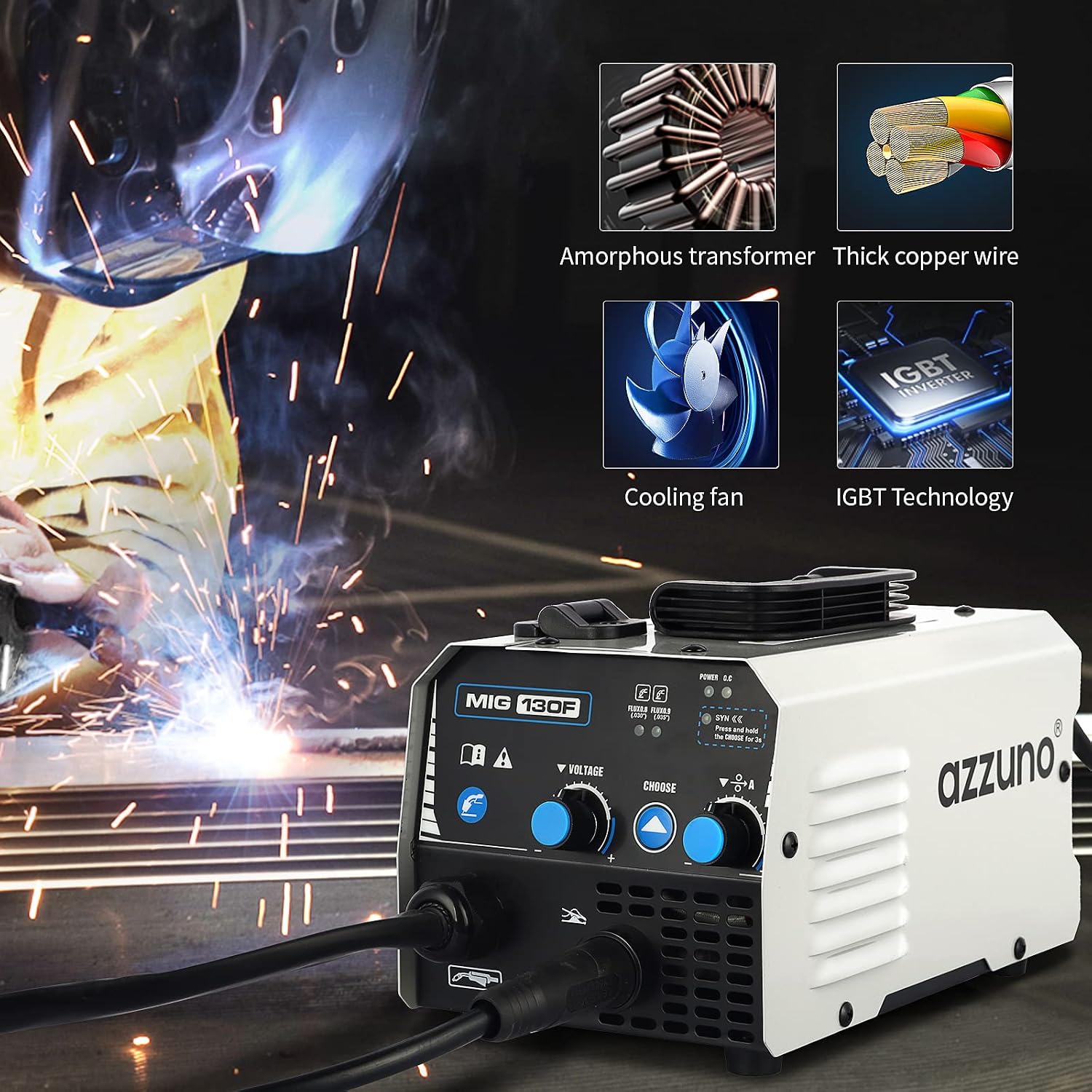
Picture this: you picked up a 110V flux-core welder — a machine that plugs into a standard household outlet, no special wiring needed — and you’re ready to weld a trailer hitch bracket or patch a cracked garden cart. You dial up the power, strike an arc, and the bead either blows right through the metal or sits on top like a cold lump of slag. Something’s off, but the manual isn’t helping. The real problem? You haven’t matched the machine’s amperage (the amount of electrical current driving the weld, which controls heat) to the actual thickness of the steel in front of you. That mismatch is the single most common reason garage welders get frustrated with 110V machines. This guide walks you through the amperage-to-thickness relationship, explains what a 110V machine can and cannot realistically do, and gives you a clear decision frame for buying or using one.
| EDITOR'S PICK[FORNEY Easy Weld 140 Amp 120-Vo…](https://www.amazon.com/dp/B07CP9CDVQ?tag=greenflower20-20) | Mid-tier[YESWELDER 135A MIG Welder](https://www.amazon.com/dp/B08CBBHFX5?tag=greenflower20-20) | Budget pick[AZZUNO MIG Welder](https://www.amazon.com/dp/B0B6HL28ZP?tag=greenflower20-20) | |
|---|---|---|---|
| Amperage | 140 A | 135 A | 130 A |
| Voltage | 120 V | 110 V | 110 V |
| Processes | Flux-core | MIG/Lift TIG/Stick | Flux-core |
| Wire Included | — | ✓ | — |
| Synergic Control | — | ✓ | — |
| Display | — | LED | — |
| Price | $265.50 | $109.99 | $69.99 |
| See on Amazon → | See on Amazon → | See on Amazon → |
What a 110V Flux-Core Welder Actually Delivers — Spec Sheet vs. Reality
Here’s the honest starting point: a 110V flux-core welder is not a lite version of a 220V machine. It’s a different class of tool, with real limits that have nothing to do with build quality and everything to do with physics.
A standard North American household outlet delivers 110–120V at 15 or 20 amps of circuit capacity. Your welder converts that into welding current. Most 110V flux-core machines are rated between 90A and 140A at their maximum output. That sounds like a lot, but welding amperage and outlet amperage are different numbers — your 140A welder is drawing roughly 20–25A from the wall while it’s arcing, which is why a dedicated 20A circuit is strongly recommended even for entry-level machines.
The more important limitation is duty cycle — the percentage of a 10-minute window the machine can weld continuously before it needs to cool down. A machine rated “20% duty cycle at 90A” means it can weld for 2 minutes out of every 10 at that power level, then must rest. Nameplate duty cycle figures are typically measured at room temperature (around 40°C ambient in manufacturer specs, per Lincoln Electric’s flux-core technical guide). In a summer garage that hits 85–90°F, real-world duty cycle can drop 15–25% below the nameplate number. That’s not a defect — it’s thermodynamics. If your machine is tripping its thermal overload and you’re only 90 seconds into a bead, you’re either at peak amperage, in a hot shop, or both.
Flux-core specifically refers to the wire’s construction: instead of a solid wire requiring shielding gas, flux-core wire has a powdered flux compound inside the hollow wire that burns to create its own shielding. For garage use, this matters because you don’t need to buy or manage a shielding gas cylinder. The tradeoff is more spatter (tiny molten droplets that land near the bead) and slag (a glassy residue on top of the finished weld that you chip away). The weld quality is completely serviceable for structural fab, trailer work, and farm equipment — it just takes a little more cleanup than gas-shielded MIG.
The Amperage-to-Thickness Rule: A Working Framework
The industry rule of thumb, cited consistently in Miller Electric’s welding reference materials and Lincoln Electric’s process guides, is roughly 1 amp per 0.001 inches of material thickness for steel. That’s 1,000 amps per inch — which is why heavy structural welding lives in the 200–600A world, not the 90–140A world of a 110V machine.
Here’s where that rule lands for common garage steel:
| Steel Thickness | Approximate Amperage Needed | Realistic on 110V? |
|---|---|---|
| 22–24 gauge (0.030”) | 30–50A | Yes, easily |
| 18 gauge (0.048”) | 45–70A | Yes |
| 16 gauge (0.063”) | 60–90A | Yes, solid range |
| 1/8” (0.125”) | 100–130A | Yes, at or near max |
| 3/16” (0.188”) | 150–180A | No — borderline/multi-pass |
| 1/4” (0.250”) | 200–250A+ | No — requires 220V |
By the numbers: Most 110V flux-core machines top out at 90–140A. That puts the reliable single-pass limit at around 3/16” mild steel, and even that is pushing the machine hard. At 1/8”, you’re in comfortable territory. At 1/4” and above, you either need a 220V machine, or you’re doing multi-pass welds that require careful technique to achieve adequate fusion — something that AWS D1.1 structural code requirements don’t look on favorably as a production method without proper procedure qualification.
The practical sweet spot for a 110V flux-core welder is 24 gauge through 1/8” mild steel. That covers: auto body patch panels, thin-wall square tubing for furniture and brackets, light trailer components, garden equipment, sheet metal enclosures, and general repair work. It does not cover: structural trailer tongue fabrication at 1/4”, roll cage tubing at heavy wall, anything governed by a structural welding code, or heavy farm equipment repair.
Matching Wire Diameter to Amperage Range
The wire you run determines where your amperage range starts. Most 110V machines are factory-set for 0.030” or 0.035” flux-core wire (E71T-11 is the most common classification for gasless flux-core, meaning it’s an all-position wire rated for single and multi-pass welds). Here’s the short version:
- 0.030” wire runs cleanly at 50–120A and is better for thin material (22 gauge through 1/8”). It’s forgiving on low amperage settings.
- 0.035” wire runs at 75–140A and handles 1/8” through 3/16” more aggressively. It produces more spatter on thin material but penetrates better on thicker stock.
Operators across long-run reviews on forums like WeldingWeb consistently note that 110V machines feel more controllable on 0.030” wire for thin gauge — you have more room to tune voltage and wire speed independently without the arc becoming erratic. On thicker metal, the jump to 0.035” wire often produces noticeably better fusion at the same amperage setting.
Don’t run 0.045” wire on a 110V machine. The wire feed motor and drive rolls on entry-to-mid-tier 110V machines aren’t built for that diameter, and you’ll fight feed problems more than you weld.
Three Machines Worth Knowing (and What the Specs Actually Mean)
Rather than chasing the cheapest price on the shelf, calibrate to what these machines are spec’d for and who actually reports good results with them.
YesWelder MIG-205DS — Rated at up to 200A on 220V input, but can run in 110V mode capped around 130A. Owners consistently report it handles 1/8” flux-core passes cleanly in 110V mode, with wire feed stability that punches above its price point. The multi-process capability (MIG, flux-core, stick, lift-start TIG) adds versatility for shops that want one machine to grow with. Published specs list a 60% duty cycle at lower amperage settings on 220V — in 110V mode, real-world duty cycle in warm conditions will be shorter, which reviewers at Popular Mechanics’ garage welder guide flag as something to plan around on longer seams.
Hobart Handler 140 — A 110V-only machine rated to 140A with a 20% duty cycle at 90A. Lincoln Electric’s competitor positioning aside, Hobart’s Handler line has a reputation in the hobbyist-to-light-pro segment for consistent wire feed and a forgiving voltage/wire speed relationship. Grainger’s product spec listings confirm the Handler 140 runs 0.030” and 0.035” E71T-11 wire and has a recommended capacity of 24 gauge through 1/4” — though that 1/4” rating should be understood as achievable with multiple passes and good technique, not a single-pass ticket.
Lincoln Electric PRO MIG 140 — Lincoln’s 110V entry, rated at 140A with similar duty cycle specs. Lincoln Electric’s own documentation emphasizes this machine’s compatibility with both flux-core and gas-shielded MIG (meaning you can add a gas cylinder later for cleaner welds on thinner material). Operators running light production — small brackets, furniture, occasional repair — note in aggregated reviews that the arc quality is consistent and the machine tolerates the voltage fluctuations common in residential wiring better than some offshore competitors.
The Decision Frame: If X, Then Y
If you’re still deciding whether a 110V flux-core machine solves your problem — or if you need to step up — here’s the honest filter:
If your work is primarily 18 gauge through 1/8” mild steel, a 110V flux-core machine is the right tool. You’ll operate comfortably in the machine’s rated amperage range, duty cycle won’t be a daily frustration, and you won’t be fighting the physics of the outlet.
If you regularly weld 3/16”, a 110V machine can get there with multi-pass technique and patience, but you’ll be pushing the machine hard and fighting its duty cycle. Budget for a 220V outlet installation now, even if you buy 110V today — it’s a $150–$300 electrical job that future-proofs your shop.
If you’re at 1/4” or heavier, a 110V flux-core welder is the wrong tool for the job, full stop. The physics don’t bend for brand loyalty or price. A 220V multi-process machine like the ESAB Rebel EMP 235ic or Lincoln Power MIG 260 is where that work belongs.
If certification is on your roadmap — if you’re working toward a D1.1 structural cert or an API pipeline certification — do not build your practice habits on a 110V flux-core machine. The process parameters, deposition rates, and joint preparation required for certified work live in a different amperage universe. Use the 110V machine for what it’s good at; invest in a proper 220V rig for anything you plan to certify on.
One last thing worth naming: the best 110V machine you can buy still can’t overcome a bad extension cord. A long, undersized extension cord — anything under 10 AWG for runs over 25 feet — will drop voltage at the machine and make your arc feel sluggy and inconsistent in ways that look like a machine problem but aren’t. Run a short, heavy-gauge extension cord or better yet, wire a dedicated outlet near your work area. The machine will perform closer to its nameplate ratings, your welds will improve, and you’ll stop blaming the equipment for a wiring problem.
The 110V flux-core welder is genuinely useful for a significant slice of garage and light shop work. Know the lane it belongs in, match your wire and amperage to the metal in front of you, and it’ll earn its keep.