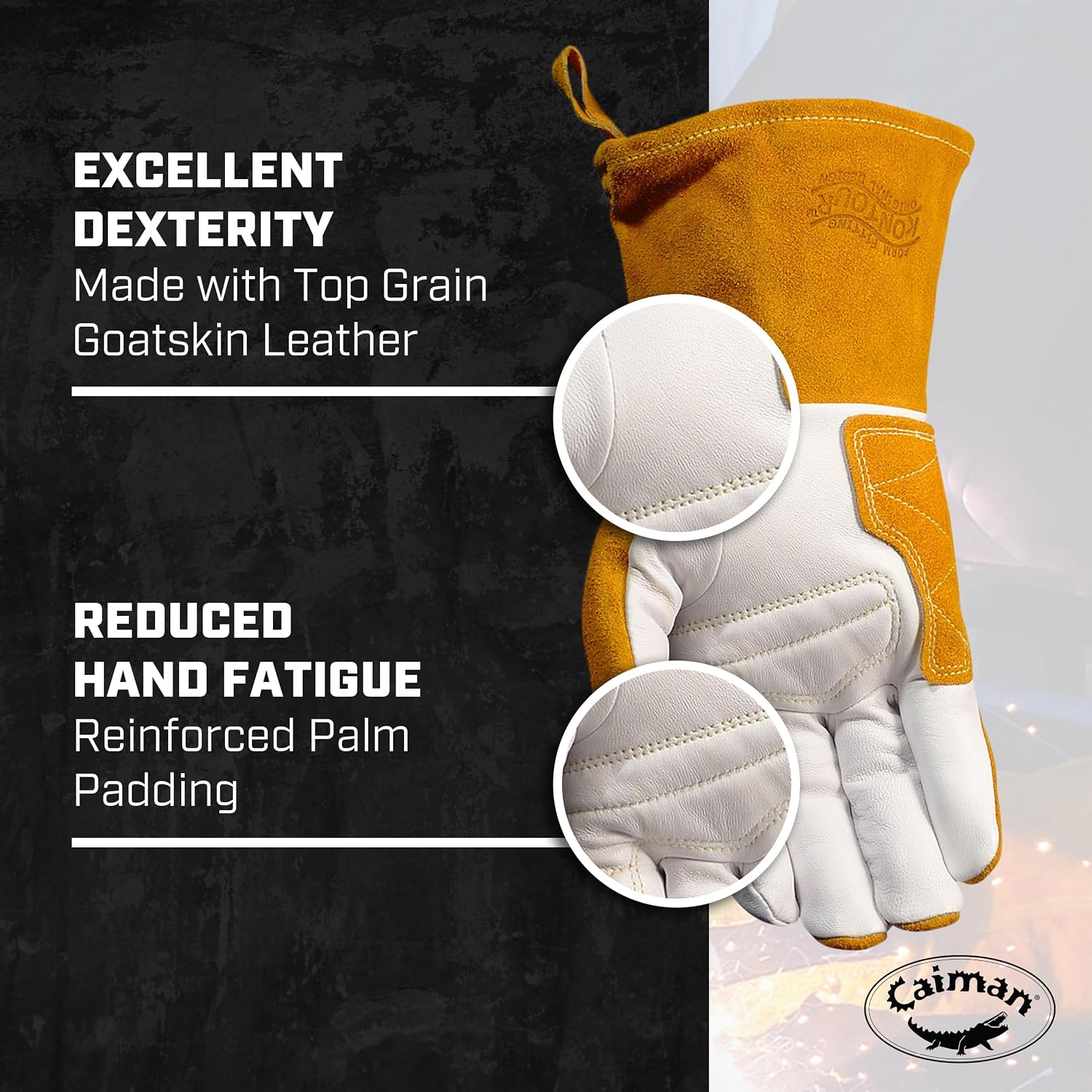
If you’ve ever picked up a TIG torch with a pair of thick MIG gloves on, you already know the problem: it feels like trying to thread a needle while wearing oven mitts. TIG welding — short for Tungsten Inert Gas welding, a process that uses a non-consumable tungsten electrode and a separate filler rod held in your other hand — demands precise, close-up control of both the torch and that filler rod simultaneously. MIG welding (Metal Inert Gas, where wire feeds automatically through the gun) is a faster, higher-heat process where bulk protection matters more than fingertip sensitivity. The gloves built for each process reflect that difference completely. This article breaks down exactly what that tradeoff looks like in practice, what the specs mean, and how to decide which glove — or combination of gloves — belongs in your kit based on how you actually work.
| EDITOR'S PICK[Caiman Premium Split Deerskin M](https://www.amazon.com/dp/B00HSFKBWW?tag=greenflower20-20)… | Mid-tier[Lincoln Electric Traditional MI](https://www.amazon.com/dp/B00547HD0O?tag=greenflower20-20)… | Budget pick[Tillman 1328 Top Grain Goatskin](https://www.amazon.com/dp/B01N6I37BP?tag=greenflower20-20)… | |
|---|---|---|---|
| Length | 21 inch | 14 inch | — |
| Material | Deerskin | Leather | Goatskin |
| Lining | Fleece/Foam | Lined | — |
| Stitching | Kevlar | Kevlar | — |
| Glove type | MIG/Stick | MIG/Stick | TIG |
| Price | $52.02 | $28.23 | $15.20 |
| See on Amazon → | See on Amazon → | See on Amazon → |
Why the Glove You Grab Changes the Quality of Your Weld
This isn’t a minor preference issue. The wrong glove in the wrong process is a direct threat to weld quality and, in some cases, to your safety.
Here’s the core tension: protection requires material thickness, and dexterity requires thinness. Those two things are physically at odds. A TIG welder holding a filler rod at a precise angle, feeding it into a puddle millimeter by millimeter, needs to feel the rod between their fingers the way a surgeon needs to feel suture tension. A MIG or flux-core welder running stringer beads on structural steel is generating more radiant heat, more spatter, and more UV radiation — and their glove needs to stop all of that before it gets to skin.
The American Welding Society, in its general PPE safety guidance and in AWS F2.2 (Lens Shade Selector and General Safety in Welding), consistently emphasizes matching hand protection to the specific arc process and heat exposure level. That’s not boilerplate — it’s the entire design philosophy behind why TIG gloves and MIG gloves are built so differently.
The numbers, side by side:
| Feature | TIG Gloves | MIG/Stick Gloves |
|---|---|---|
| Leather thickness | 0.5–0.8 mm (goatskin or deerskin) | 1.2–2.0 mm (cowhide or pigskin) |
| Typical cuff length | 4–6 inches | 8–14 inches |
| Spatter resistance | Low to moderate | High |
| Fingertip sensitivity | High | Low |
| Heat resistance at palm | Moderate | High |
TIG Gloves, MIG Gloves, and Multi-Process Gloves: A Tier-by-Tier Comparison
Not every welder needs to stock three separate pairs of gloves — but understanding the performance difference at each tier helps you spend where it counts. The three sections below break the glove market into the categories that actually matter for intermediate practitioners: dedicated TIG, dedicated MIG/stick, and multi-process compromise options.
TIG Gloves: Optimized for Feel
TIG gloves are built around one priority: tactile feedback. The process requires you to manually guide a filler rod with your non-torch hand, feeding it into a weld puddle that might be only a few millimeters wide. You need to feel the rod, feel the angle, and make micro-corrections constantly. A glove that deadens that feedback will show up immediately in your bead quality — inconsistent filler additions, contaminated tungsten from accidental dips, and wandering puddles.
Material matters most here. Goatskin and deerskin are the dominant choices for TIG gloves because both leathers are naturally thin, soft, and form-fitting without sacrificing basic heat resistance. Deerskin, in particular, is known among TIG practitioners for becoming more supple with use — operators in long-run shop settings frequently note that a quality deerskin TIG glove “breaks in” over the first few sessions and actually improves in feel. Goatskin tends to hold its shape better and is slightly more resistant to abrasion, making it a common choice for production-floor TIG work.
Lincoln Electric’s Welding Safety — Personal Protective Equipment Guide (lincolnelectric.com) specifically calls out the importance of lightweight, unlined gloves for GTAW (Gas Tungsten Arc Welding — TIG’s formal designation), noting that lined gloves add bulk that compromises torch manipulation accuracy. Miller Electric’s Welding Gloves Selection Guide (millerwelds.com) echoes this, distinguishing TIG-appropriate gloves by their finger articulation and relatively short cuff — enough to protect the wrist without the heavy gauntlet that a stick welder needs.
What TIG gloves don’t do well: They are not rated for heavy spatter or high arc-on radiant exposure. If you’re doing any MIG or stick work in the same shift and you reach for your TIG gloves out of habit, you’re underprotected. Spatter will burn through thin goatskin quickly, and the shorter cuff leaves your forearm vulnerable in overhead or out-of-position work.
Price range to know: Entry-level TIG gloves from credible brands typically run $15–$35. Professional-grade options in deerskin with reinforced thumb seams and seamless fingertips run $40–$70.
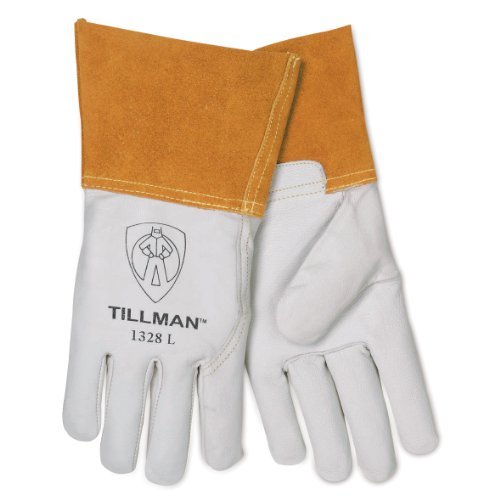
Tillman
$15.20
In stock on Amazon
Check price on AmazonMIG and Stick Gloves: Optimized for Protection
Where TIG gloves optimize for feel, MIG and stick gloves optimize for survivability. The threat profile is simply different: higher spatter velocity and volume, longer sustained arc exposure, greater radiant heat from higher amperage settings, and in stick welding, the occasional spark shower that can travel significant distance.
Cowhide and pigskin dominate this category. Cowhide splits — the lower layers of the hide separated during tanning — are the most common material in budget MIG gloves because they’re thick, widely available, and genuinely resistant to spatter and abrasion. Full-grain cowhide costs more but lasts longer and maintains better dexterity for its thickness class. Pigskin is a middle-ground option: more breathable than cowhide (the hide’s natural pores remain open), which matters during long production runs in warm shops, but slightly less abrasion-resistant.
Cuff length is where you’ll see the biggest functional difference from TIG gloves. A standard MIG gauntlet runs 8–10 inches; heavy-duty stick or flux-core gauntlets can extend to 14 inches. That extra cuff coverage isn’t decorative — it protects the forearm from radiant heat and falling spatter during overhead work, which is genuinely common in structural and pipeline contexts.
Grainger’s Welding Gloves Buying Guide (grainger.com) notes that glove selection for MIG and stick should account for liner construction. Many MIG gloves include a cotton or foam liner that provides additional thermal insulation, accepting the tradeoff of reduced dexterity in exchange for longer wear comfort during extended arc-on periods.
The duty cycle connection: Duty cycle — the percentage of a ten-minute window your machine can run at rated amperage before needing to cool — determines how long you’re actually holding a live torch. If you’re running a production MIG setup at 80–90% duty cycle, your hands are near that arc for a significant portion of every hour. At those exposure levels, the thermal protection of a proper MIG gauntlet isn’t optional.
Price range: Solid MIG/stick gauntlets from established safety brands start around $20–$45. Operator-reviewed premium options with reinforced palm patches, full-grain leather, and extended cuffs run $50–$90.
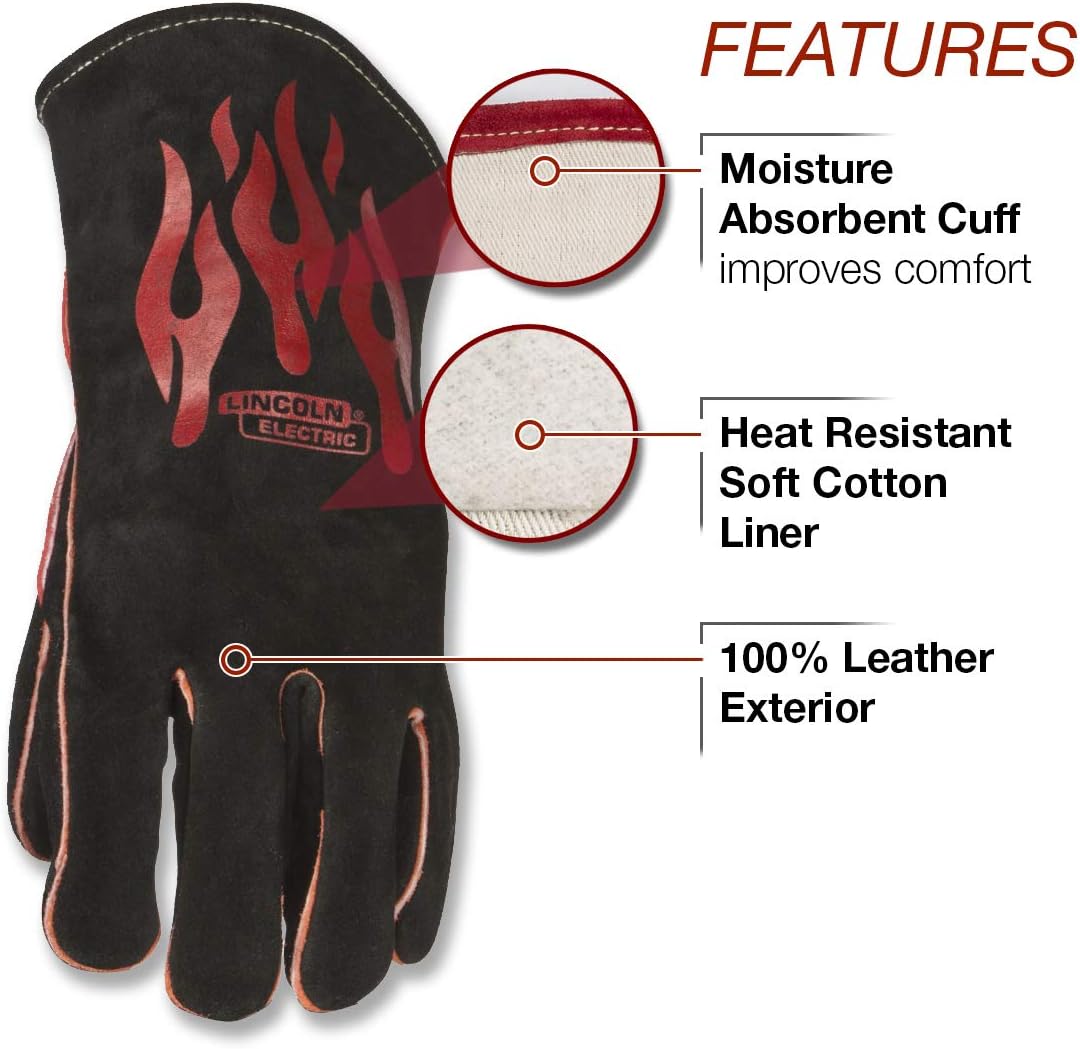
Lincoln
$28.23
In stock on Amazon
Check price on AmazonMulti-Process and Premium-Tier Gloves: When You Need Both Properties
Most real shops don’t run just one process. You might be TIG welding stainless root passes in the morning and MIG filling on structural carbon steel in the afternoon. A small but meaningful segment of the glove market targets exactly this situation: multi-process gloves that attempt to split the difference between dexterity and protection.
These gloves typically use a medium-weight goatskin or kangaroo leather palm — thicker than a dedicated TIG glove but thinner than a standard MIG gauntlet — combined with a moderate cuff length of 6–8 inches and minimal or removable lining. The tradeoff is real: they outperform MIG gloves for feel and outperform TIG gloves for spatter resistance, but they don’t fully match either specialist option at its own task.
ESAB’s Welding PPE and Hand Protection Overview (esabna.com) reinforces that certified welders working in mixed-process environments should select gloves specifically rated for the amperage range and position of the work — not defaulting to a single general-purpose option across all tasks. For pipeline and certified structural work, that typically means maintaining dedicated gloves for each process rather than relying on a compromise product.
Pipeline and structural fabricators working in certified environments sometimes specify gloves that meet ANSI/ISEA 105 cut-resistance ratings in addition to heat protection. Those purpose-built premium options start around $60 and often include documented material specs — look for stated leather thickness or hide grade before paying the premium.
Price range: Quality multi-process gloves run $45–$80. True premium single-process gloves with certified ratings start at $60–$90 and up.
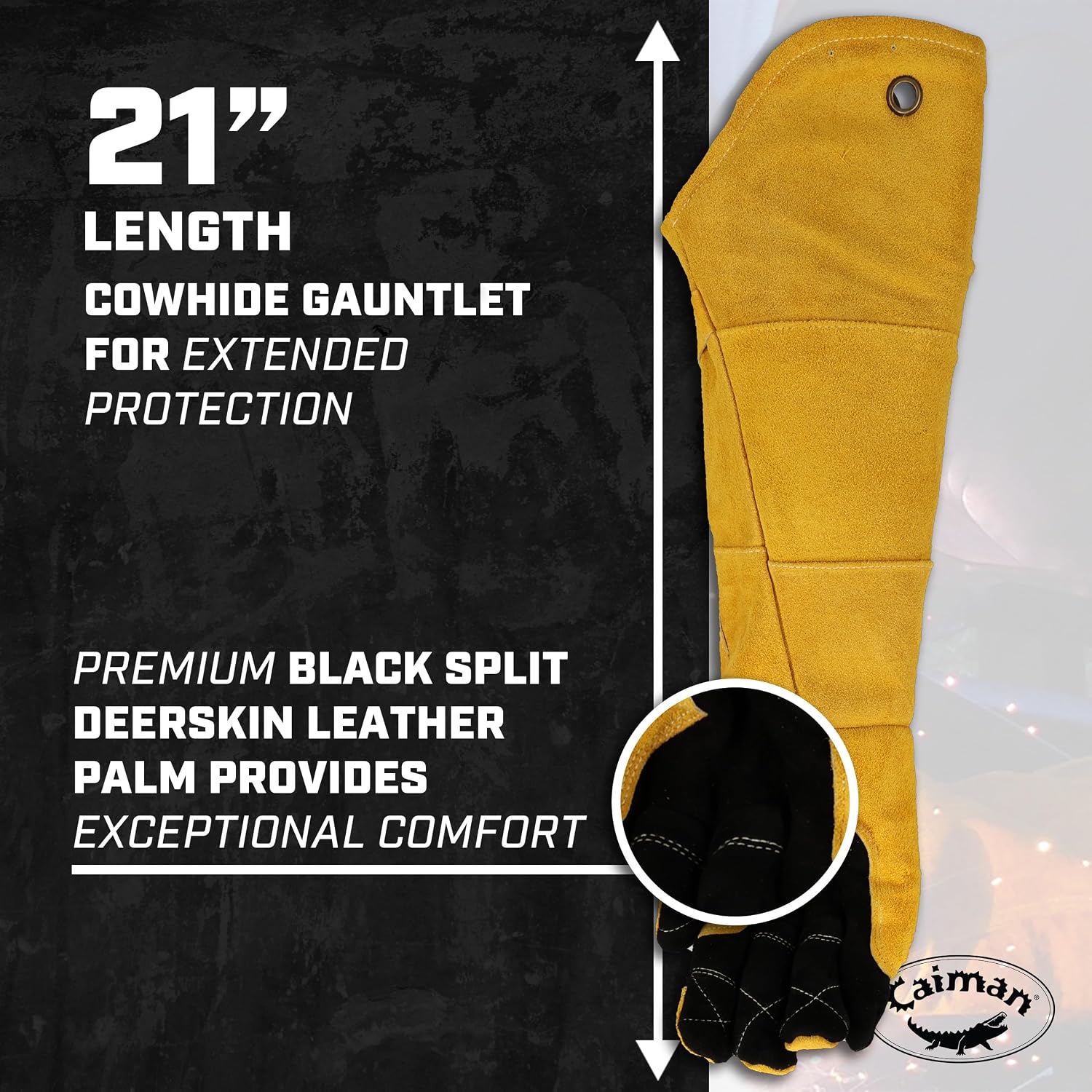
Caiman 1878-5
$52.02
In stock on Amazon
Check price on AmazonThe Real-World Decision: Process Mix and Job Context
Here’s where intermediate practitioners usually get tripped up: the instinct to grab whatever glove is closest to the bench. The discipline to match the glove to the process is the same discipline that separates consistent weld quality from inconsistent results.
A practical decision framework:
-
If you’re doing dedicated TIG work — precision fabrication, pipe root passes, aluminum with an AC TIG machine, food-grade or sanitary stainless — invest in a quality deerskin or goatskin TIG glove. Don’t compromise on feel. A $55 deerskin glove will meaningfully outperform a $20 option on a tight root gap.
-
If you’re running MIG or flux-core as your primary process — structural, heavy fabrication, production runs — a full cowhide gauntlet is the right call. The dexterity loss is acceptable for the process, and the protection is non-negotiable.
-
If you’re doing multi-process work in a single shift — and this is common in small shops and contracting environments — keep dedicated gloves for each process on hand and be disciplined about the swap. The instinct to “just finish this tack with the TIG gloves” is how you end up with burned-through leather and a near miss. The gloves are $30–$70. The consequences of the wrong glove at the wrong moment are not.
-
If you’re billing for certified structural or pipeline work — where weld quality is inspected and your hands are your livelihood — there’s no negotiation. Both Lincoln Electric’s PPE guidance (lincolnelectric.com) and ESAB’s hand protection overview (esabna.com) reinforce that certified welders should select gloves specifically rated for the amperage range and position of the work, not grabbing whatever’s available.
One more factor: shop temperature and seasonal context. In a cold-weather shop or on an outdoor jobsite in winter, a lined MIG gauntlet that feels bulky in summer becomes much more reasonable. Conversely, in a hot shop running long shifts, even a moderately lined glove creates enough hand fatigue to affect weld quality by hour four. Breathability — a genuine advantage of pigskin MIG gloves — is worth weighing if heat exhaustion is a real factor in your environment.
The Bottom Line: A Clear If/Then Decision Rule
The dexterity-protection tradeoff in welding gloves isn’t a puzzle to be solved — it’s a deliberate choice you make based on the process in front of you.
If your primary process is TIG, optimize for feel. Buy the thinnest full-leather glove rated for arc exposure that still lets you feel the filler rod. Deerskin at the $40–$70 tier is where most serious TIG practitioners land.
If your primary process is MIG, flux-core, or stick, optimize for protection. A full cowhide gauntlet with an 8–10 inch cuff rated for your amperage range is the baseline. Budget $30–$60 for a glove that will last a production season.
If you’re multi-process — and that describes most shops at the intermediate level — budget for both, label them, and swap deliberately. The glove is a tool. Match the tool to the job, every time.